Builder project · Built at Pulse Foundry AI NYC X ABI Frameworks
OuchLess
We turned 60-page nurse notes into 3 words: bill it, flag it, skip it.
Tip: click @Pulse AI in the post to tag us.
From idea to reality
What we built
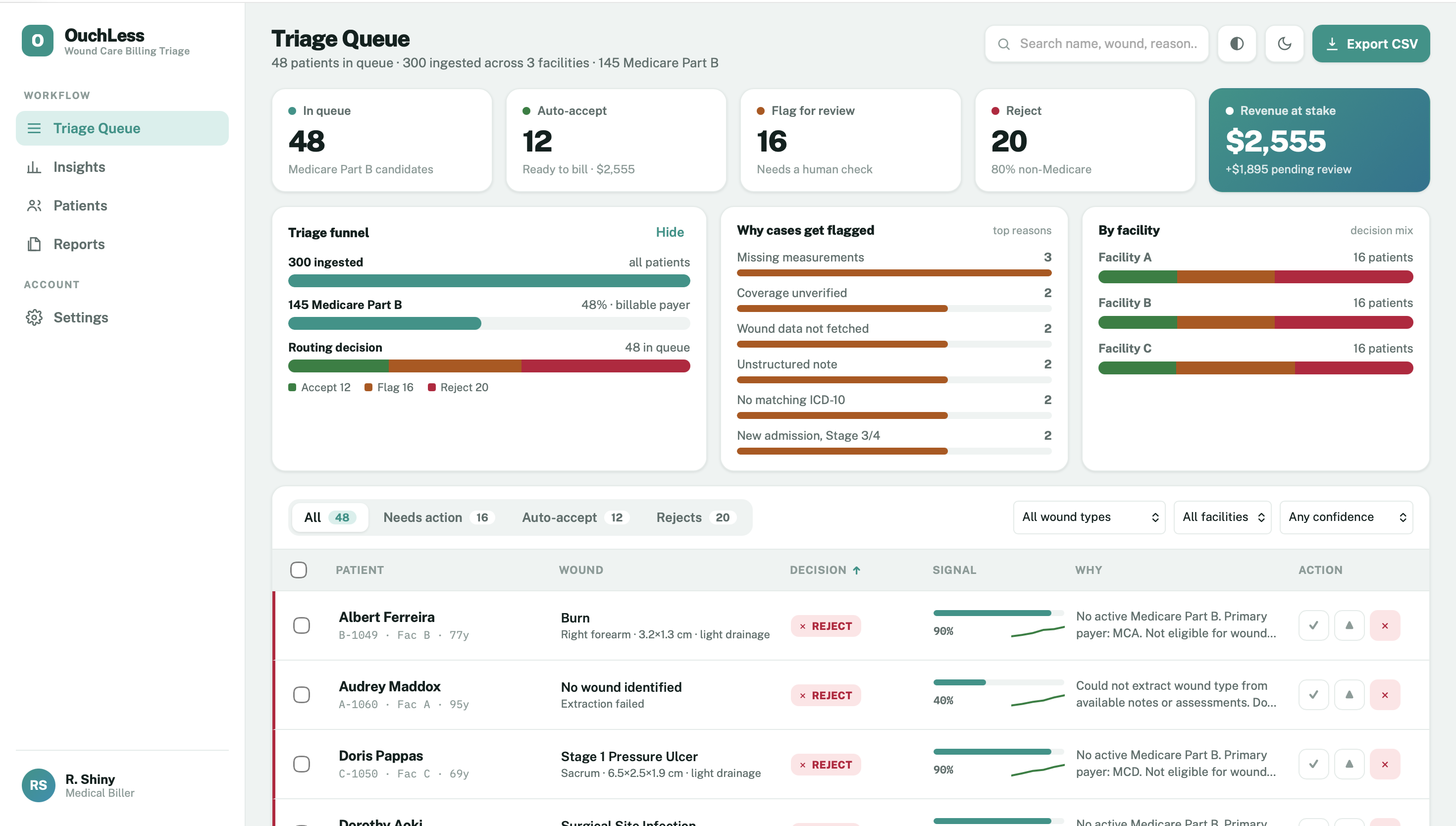
Let me start with a question. How many of you have seen a 60-page clinical note? That's what a biller at a post-acute care facility opens every morning. For every patient. To answer one question: can I bill Medicare for this wound care visit today? They're looking for five things buried somewhere in those notes: wound type, stage, measurements, drainage level, and whether the patient is on Medicare Part B. Manually. For hundreds of patients. Every day. We automated that entire process in 8 hours." "Here's the critical problem we solved first: the API. The PointClickCare API rate limits every single request with a 30% chance of failure. Most teams will retry and hope. We read an IEEE paper published in January 2026 that showed simple exponential backoff causes retry storms. Your threads all fail together, wait together, retry together, and fail again. Their ATB algorithm reduced 429 errors by 97.3%. We implemented it. You can see it working right here in our logs. Hundreds of 429s handled automatically, zero data lost." "Here's the second problem: the notes themselves. Clinical notes come in four completely different formats. No standardization. A SOAP note looks nothing like an Envive narrative. A multi-wound note describes two wounds and expects you to know which one to bill for. We built a hybrid extraction engine. Regex for structured formats, fast, reliable, high confidence. LLM fallback via Claude API for Envive narratives where measurements are buried in prose. And for multi-wound notes, the LLM picks the primary wound by clinical severity, most severe stage, largest area, exactly how a clinician would. We also discovered the real API assessments came in a nested sections-questions-answer format that was not in the documentation. We handled both formats dynamically." "Here's what we built beyond the brief. The hackathon asked us to route patients. We did that. But we also asked: what happens after you route them? What if you bill a patient who has been billed six times already with zero wound reduction? That is an OIG audit. We built 9 compliance flags from actual OIG enforcement actions and the DOJ 2025 healthcare fraud takedown. The one that matters most: if a wound shows no measurable healing progress across three or more visits, we flag it before the next claim goes out. We never treat a failed API call as a reason to reject a patient. A rate-limited endpoint is a data problem, not proof of ineligibility. Failed fetch means flag for review. Final decisions only when we have the data." "The result. 300 patients. 893 API calls, down from 1,203 without our optimization. 51 patients ready to bill today. 69 flagged for review. 180 correctly eliminated as non-Medicare. Let me show you what a biller actually sees. Three buckets. Submit Today. Review First. Do Not Bill. Every patient has a plain-English reason. No raw data, no ICD-10 codes, no clinical jargon. Just what to do next. And this is the compliance risk panel. These are the patients that are technically billable but should not be billed yet. Stalled wounds. High visit frequency. Measurement inconsistencies. The patterns that trigger federal audits." "One last thing on scale. At 300 patients we made 893 calls. At 1 million patients, our incremental sync brings that down to 20,000 calls per day, a 99.5% reduction. This is not a hackathon prototype. This is a production architecture." "ABI Frameworks built the data layer. We built the wound care eligibility module that sits on top of it. Every auto-accept is revenue recovered. Every compliance flag is an audit avoided. That is the value