Builder project · Built at Pulse Foundry AI NYC X ABI Frameworks
WoundRoute
Turning messy wound records into clear Medicare billing decisions.
Tip: click @Pulse AI in the post to tag us.
From idea to reality
What we built
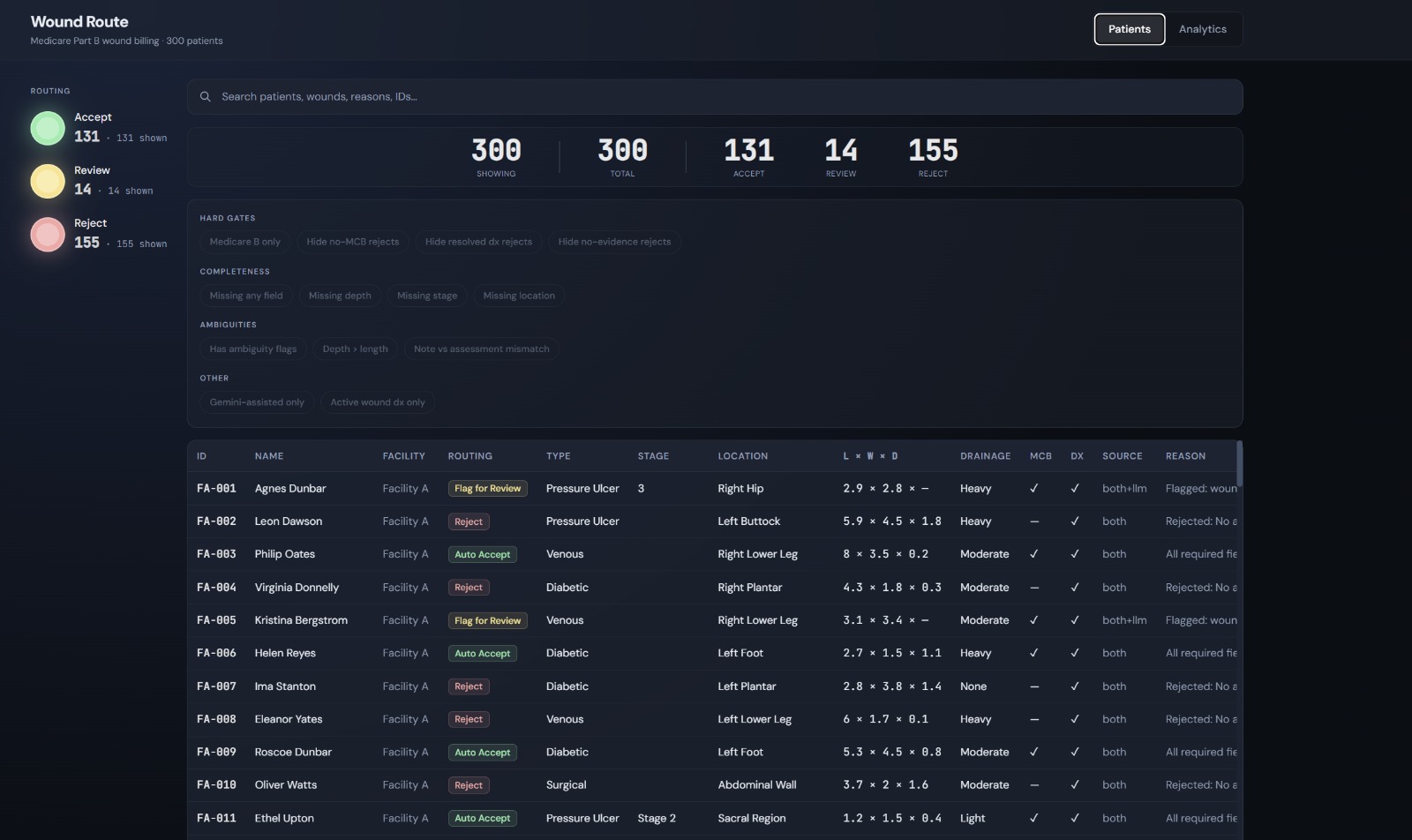
What we built We built WoundWise, an AI-assisted wound-care billing triage pipeline that helps billers quickly identify which post-acute care patients are ready for Medicare Part B wound billing, which patients need human review, and which patients should be rejected due to non-billable coverage. The problem is that wound billing decisions depend on information scattered across multiple sources: insurance coverage, diagnoses, structured assessments, and free-text clinical notes. Manually reviewing all of this is slow, repetitive, and easy to get wrong, especially when key fields like wound depth, drainage, location, or pressure ulcer stage are missing. How it works Our pipeline starts by ingesting data for 300 patients from the mock PCC API across three facilities. It fetches patient records, diagnoses, coverage, notes, and wound assessments, then stores everything in a SQLite database for auditing and reruns. Next, the extraction layer pulls out the required wound documentation: wound type, location, length, width, depth, drainage amount, and pressure ulcer stage when applicable. The system prioritizes structured assessments first because they are more reliable, then uses regex on clinical notes to fill only missing fields. We also added an optional Gemini gap-fill layer for messy documentation. Gemini is only used on active Medicare Part B patients who still have missing fields after regex. It never overwrites existing values and only fills a gap when the answer is clearly supported by the clinical text. Finally, the eligibility engine routes each patient into one of three outcomes: auto_accept: active Medicare Part B and complete wound documentation flag_for_review: potentially billable, but missing or suspicious documentation reject: not eligible, usually because the patient does not have active Medicare Part B Results Out of 300 patients, the system found: 131 auto_accept patients ready for billing 14 flag_for_review patients needing human review 155 reject patients with non-billable insurance coverage Regex alone produced 117 auto-accepts. Gemini recovered 14 additional patients, improving the final ready-to-bill count to 131. The remaining 14 review cases are explainable: most are missing wound depth, two are false flags caused by a known zero-depth handling bug, and two have suspicious measurements where depth is greater than length. Why it matters WoundWise turns scattered clinical and insurance data into a clear, explainable billing worklist. Instead of asking billers to manually review every patient, it helps them focus first on patients who are ready to bill, quickly identify documentation gaps, and safely exclude patients with the wrong coverage. This matters because healthcare billing needs both speed and trust. Our system combines deterministic rules, clinical extraction, AI-assisted gap filling, and a Streamlit dashboard to create a workflow that is faster, safer, and auditable.