Builder project · Built at Pulse Foundry AI NYC X ABI Frameworks
Billsense
Turns raw PCC records into cited, auto-routed wound-care billing decisions, every call backed by ev
Tip: click @Pulse AI in the post to tag us.
From idea to reality
What we built
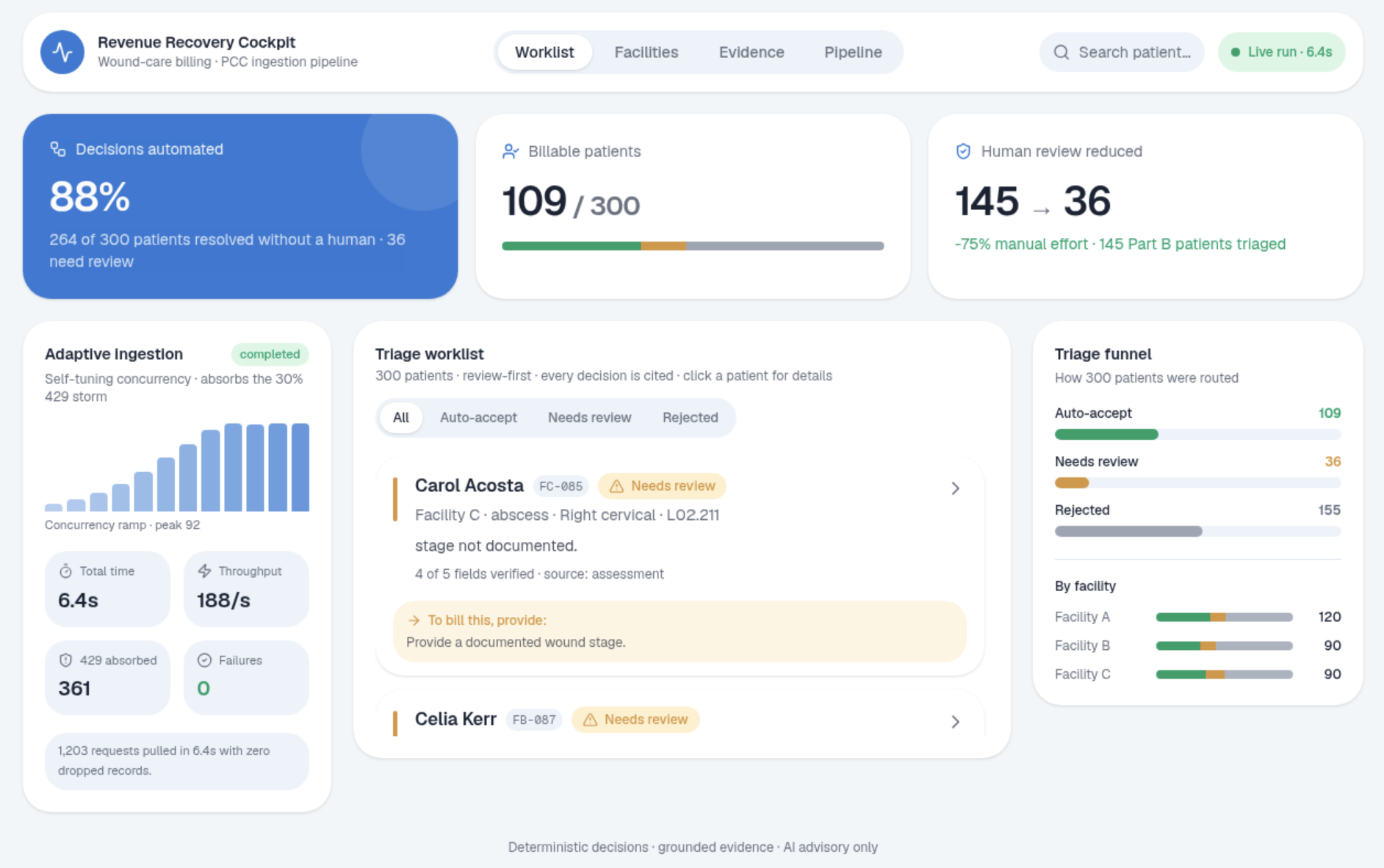
## Overview Wound-care billing requires Medicare Part B coverage and a fully documented wound. That documentation is scattered across structured assessments and free-text clinical notes, behind a flaky API. We built a pipeline that ingests it all, extracts the wound fields, and routes every patient into one of three decisions - auto-accept, flag-for-review, or reject — with the source evidence attached to each call. ## How it works 1 · Ingestion (handles a hostile API). The API fails ~30% of requests at random. Instead of a serial retry loop, we use an adaptive-concurrency engine that fans out all ~1,200 per-patient calls in parallel, honors `Retry-After`, and self-tunes its worker pool - finishing in seconds with zero dropped records. 2 · Extraction (structured + free-text).** Structured assessment JSON is treated as the gold source; clinical notes are scanned in a single linear Aho-Corasick pass against a clinical lexicon (wound types, locations, drainage) plus a measurement grammar for `L x W x D`. Every extracted field carries its source and a confidence tag (`verified / missing / AI-assisted`). 3 · Routing (deterministic, explainable). A pure decision lattice combines the Part B coverage gate with wound-field completeness. No active Part B or no documentable wound → reject. All required fields present and corroborated → auto-accept. Anything in between → flag-for-review, with a precise note of which field is missing and what document would resolve it. AI is advisory only — it can fill a gap for human review but can never produce a billable decision. ## Why it matters Billers don't get a black-box "eligible" list - they get a ranked worklist where every decision cites the exact note or assessment behind it, and every rejection comes with a fix. On the real dataset: 300 patients → 109 auto-accept, 36 flag-for-review, 155 reject (145 with Part B), shrinking the cases a human must touch by ~75%. ## Schema & output Output is a flat, queryable `decision_output.json` (and CSV): patient id, decision, wound fields, per-field confidence map, source format, ICD-10, and remediation steps — easy to filter by decision, facility, or wound type. ## Handling ambiguity When a note and an assessment describe the same wound differently, we reconcile deterministically — one source *refining* another (e.g. "foot" vs "left foot") is not a conflict — and only escalate genuine disagreements or true missing data to a human. Tradeoff: we favor a human safety net over silent auto-billing, so borderline cases route to review with the exact reason rather than being guessed. ## Demo notes for judges - Dashboard hero shows the three-way routing split and review reduction. - Open any worklist card → Show evidence to see each wound field, its source, and its confidence — including which missing field drove a flag/reject. - Filter by Auto-accept / Needs review / Reject to follow the routing logic live.