Builder project · Built at Pulse Foundry AI NYC X ABI Frameworks
Care Claim
Healthcare goes pass billing and ETL issues
Tip: click @Pulse AI in the post to tag us.
From idea to reality
What we built
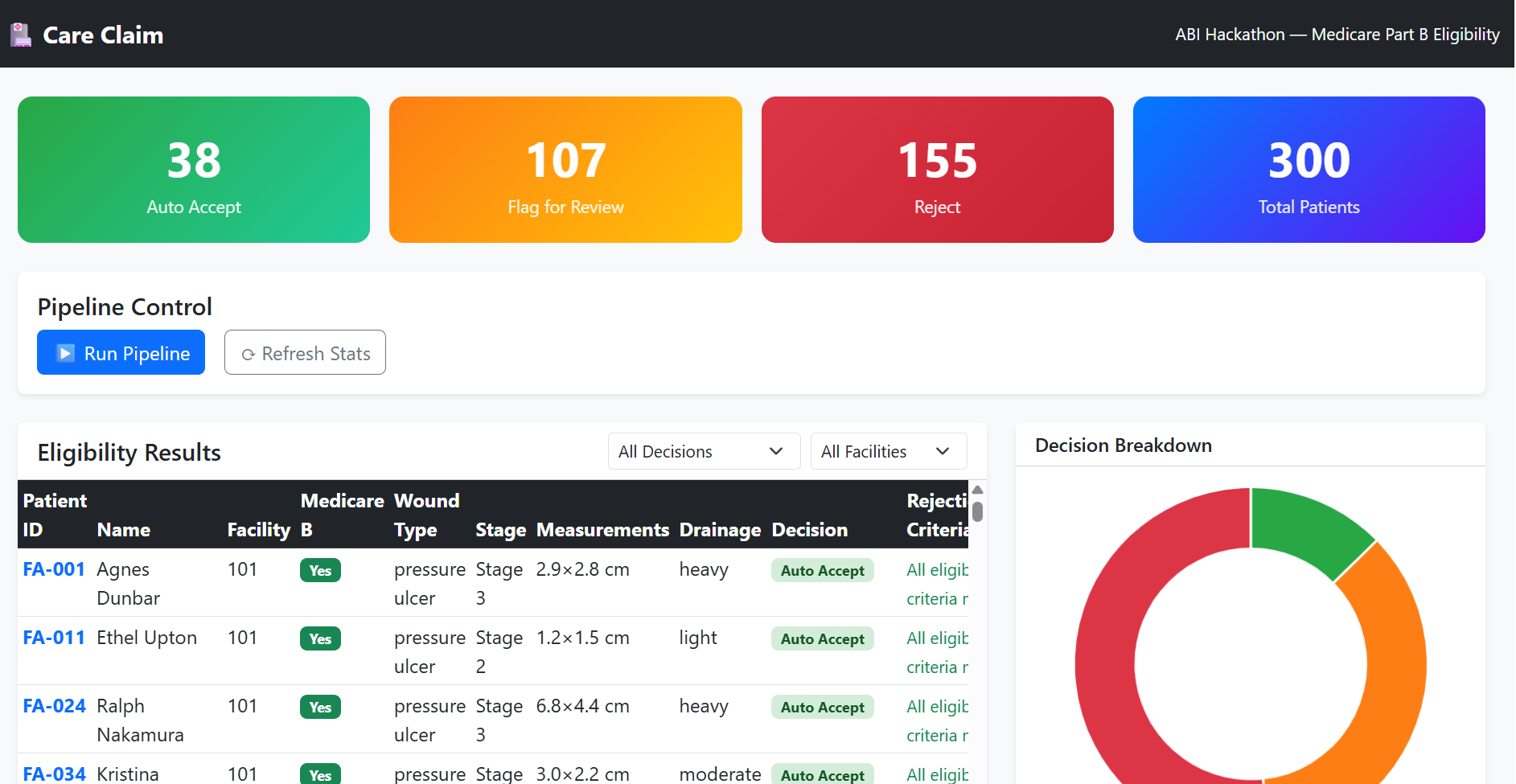
# Care Claim — Judge Walkthrough --- ## The Problem Post-acute care facilities bill Medicare Part B for wound care services. Today, a human biller manually reviews every patient chart — reading free-text nursing notes, pulling up coverage records, checking wound measurements — before deciding whether to submit a claim. With 300 patients across three facilities, that's hundreds of hours of repetitive, error-prone work every billing cycle. **Care Claim automates that entire workflow.** --- ## What We Built A fully automated, end-to-end clinical data pipeline with a live web dashboard — built in a single hackathon session. ``` PCC API → Ingestion → Extraction → Eligibility → SQLite → Dashboard ``` ### 5 Specialized Agents | Agent | Job | |---|---| | **Patient Agent** | Fetches all 300 patients across Facilities 101, 102, 103 | | **Clinical Agent** | Pulls diagnoses, coverage, notes, and assessments per patient | | **Extraction Agent** | Parses wound data from free-text notes and structured assessments | | **Eligibility Agent** | Applies Medicare Part B rules and issues a routing decision | | **Orchestrator** | Runs all agents concurrently (15 threads), coordinates DB writes | --- ## The Hard Part: Extraction The notes come in four radically different formats. All of these mean the same thing to a clinician: ``` SOAP note: Length: 4.2 cm Width: 3.1 cm Depth: 1.5 cm Prose note: Meas 4.2x3.1x1.5cm, moderate drainage Envive note: Stage III pressure injury sacrum measuring 4.2 × 3.1 × 1.5 cm with moderate serous drainage Multi-wound: Wound 1: DFU right heel... Wound 2: Stage II PU coccyx... ``` We built a multi-pattern regex extraction engine that handles all of them — 6 measurement patterns, 11 wound type patterns, 6 stage patterns, 4 drainage levels, and 35 anatomical location keywords. Candidates are scored by how many fields they fill, and the best one wins. --- ## The API Challenge: 429s The PCC API rate-limits aggressively — **30% of all requests return HTTP 429**. A naive pipeline fails silently and produces blank records. Our `api_client.py` handles this with: - Up to **20 retries** per call, respecting the `Retry-After` header - **15 concurrent workers** so retries on one patient don't block others - A **failed call log** — any call that exhausts all retries is written to `failed_api_calls` in the DB ## Why It Matters A biller today opens 300 charts. They read notes in four different formats, check insurance records, do math on wound dimensions, and decide — one patient at a time. Care Claim does that in minutes, not days. The **auto-accept** cohort goes straight to billing with no human review. The **flag-for-review** cohort gets a prioritized worklist with the exact gap highlighted. The **reject** cohort is filtered out before it wastes anyone's time. And when the API fails — as it always does in production — no data is silently dropped. The pipeline catches it, logs it, and gives you a one-click path to recover it. **That's the difference between a script and a production system.**