Builder project · Built at Pulse Foundry AI NYC X ABI Frameworks
ABI Wound Intelligence Pipeline
An automated data pipeline records, extracts wound-care information for Medicare Part B billing.
Tip: click @Pulse AI in the post to tag us.
From idea to reality
What we built
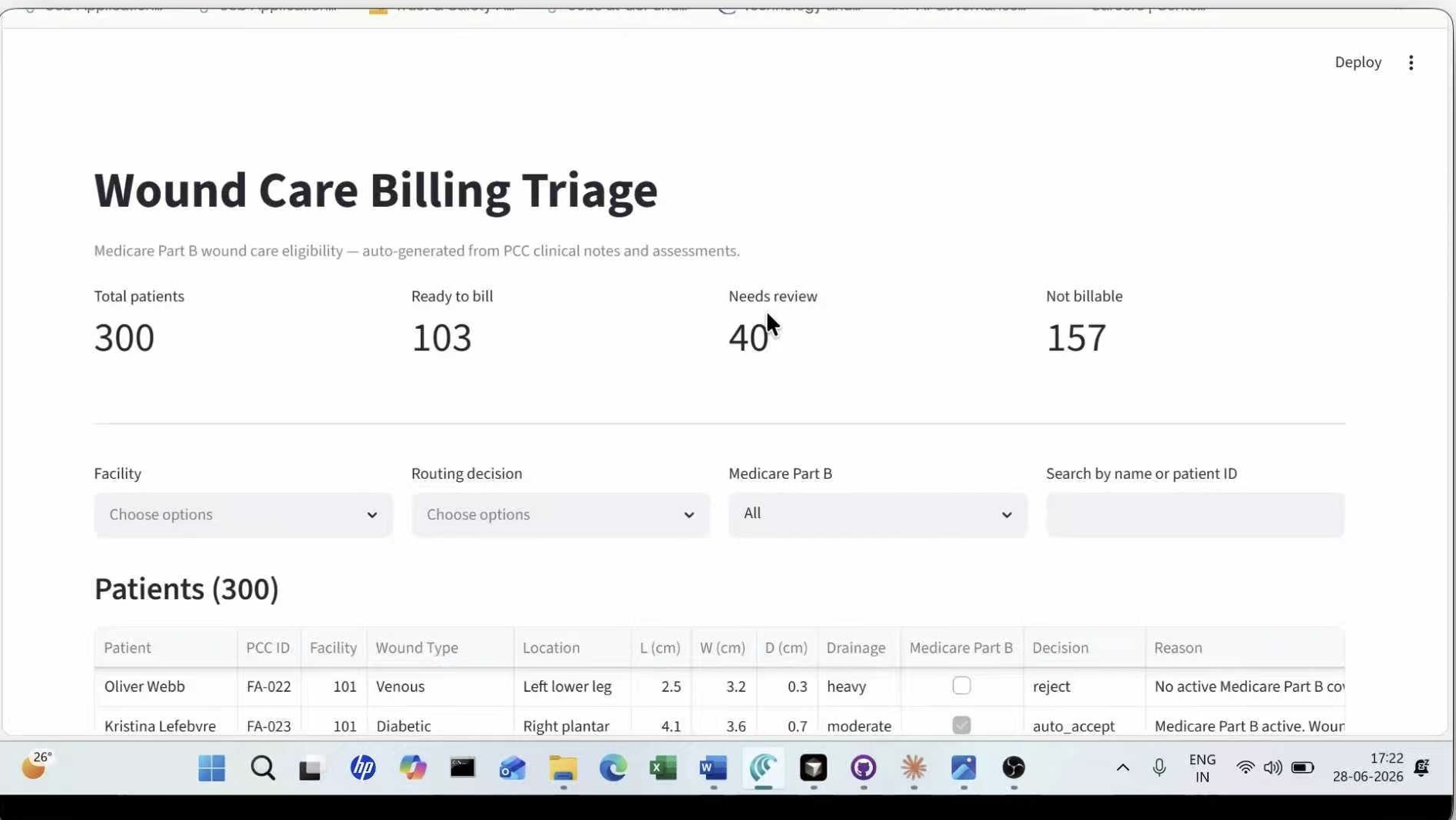
Healthcare billers spend significant time manually reviewing patient records to determine whether wound care services qualify for Medicare Part B reimbursement. Clinical information is often scattered across multiple API endpoints, structured assessments, physician notes, diagnoses, and insurance records. Because wound documentation varies from structured forms to free-text clinical narratives, eligibility review is repetitive, time-consuming, and prone to inconsistencies. Our project addresses this challenge by building an end-to-end wound care billing pipeline that automates data ingestion, clinical information extraction, eligibility determination, and billing triage. The pipeline retrieves patient records from the mock PCC API with automatic retry and backoff handling for rate limits, ensuring reliable synchronization across facilities. To accurately extract wound information, we use a hybrid approach that combines rule-based parsing with LLM-assisted extraction. Structured assessment JSON is parsed directly, while SOAP notes and narrative documentation are processed using pattern matching and regular expressions. When documentation is ambiguous or highly unstructured, an LLM extracts the remaining clinical fields. Information from multiple sources is then merged into a single normalized wound record with an associated confidence score. Next, the system combines extracted wound data with diagnosis and Medicare Part B coverage information to classify each patient into one of three categories: **Auto Accept**, **Flag for Review**, or **Reject**. Every decision includes a plain-language explanation, allowing billers to quickly understand why a patient was routed and what additional verification, if any, is required. Finally, the results are presented in an interactive Streamlit dashboard featuring summary statistics, searchable patient records, eligibility status, wound measurements, insurance information, and detailed routing explanations. During the demo, we showcase the complete workflow—from API ingestion and hybrid clinical extraction to automated eligibility routing and dashboard visualization—demonstrating how the system reduces manual review, improves consistency, and helps billing teams prioritize the patients who need human attention most.