Builder project · Built at Pulse Foundry AI NYC X ABI Frameworks
Skywalkers-Health
A one‑stop shop for billers to surface missed revenue, clean fragmented records
- ✧ 1st Place
Tip: click @Pulse AI in the post to tag us.
From idea to reality
What we built
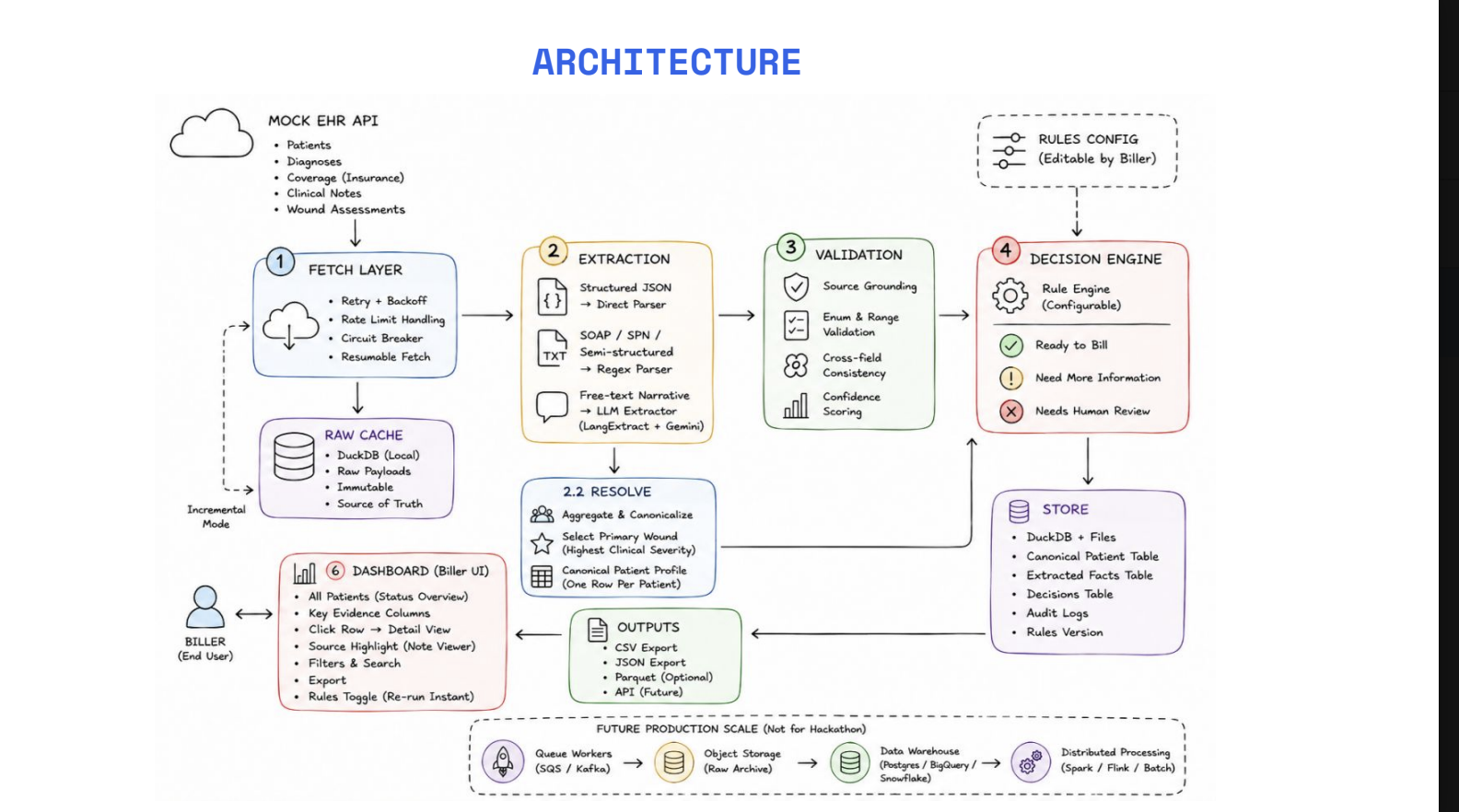
A system that helps a medical biller decide which wound-care visits can be billed. It pulls patient data from a flaky hospital API, reads the clinical notes, and recommends: bill, review, or don't bill. A human biller makes the final call on flagged cases. THE PROBLEM IT SOLVES The EHR API is unreliable — about 30% of requests get throttled or fail. AI can hallucinate — it might invent a wound size that isn't in the chart. Billing rules are complex — Medicare Part B vs Part A vs HMO, missing fields, etc. OUR APPROACH Cache everything locally first. Ground every extracted fact to the exact spot in the source note. Let a configurable rule engine decide — not the AI. THE FIVE STAGES Stage 1 — FETCH (Get the data) What it does: Downloads all patient records from the EHR API — patients, diagnoses, insurance, progress notes, and wound assessments. Stores everything in a local database (DuckDB). Why it matters: If the API goes down mid-run, we resume where we left off. We never lose data or re-fetch what we already have. We ran this against the real hackathon API and got 100% of 300 patients despite ~500 throttled requests. Stage 2 — EXTRACT (Read the charts) What it does: Pulls wound facts out of messy clinical notes — wound type, location, size, drainage, etc. Uses three tiers: structured parsing first (free, fast), regex second (for free-text notes), LLM last (only when needed). The key rule — grounded or null: Every fact must point to an exact character span in the source text. If we can't find it in the chart, we drop it. The AI never invents a measurement. Stage 3 — RESOLVE (One patient, one picture) What it does: A patient might have both an assessment and a progress note with slightly different numbers. This stage merges them into one canonical record — one primary wound, demographics, coverage, and diagnoses combined. If two sources disagree (e.g. note says depth 0.4 cm, assessment says 1.3 cm), we flag it for review instead of silently picking one. Stage 4 — DECIDE (Rules, not AI) What it does: Applies billing rules from a simple YAML config file. Three outcomes only: Ready to bill — Medicare Part B, active coverage, active diagnosis, all required wound fields present. Needs review — conditional payer (Medicare Part A, Medicaid), missing documentation, or extraction flags. Don't bill — bundled insurance (HMO), or no active coverage. Every decision includes plain-English reasons. The biller can edit the rules file without touching code. Typical results: ~67 ready to bill, ~203 need review, ~30 don't bill. Stage 5 — DASHBOARD (Biller's worklist) What it does: A web UI at http://127.0.0.1:8050 where a non-technical biller can: See all 300 patients in a filterable table (bill / review / don't bill) Read a plain Q&A summary for each patient (who, what wound, why flagged) See a documentation checklist for review cases Approve a flagged patient with one click — moves them to "Ready to bill" Expand original chart text with color highlights showing where each fact came from EXAMPLE PATIENTS TO DEMO FA-001 (Leon Davis, HMO): Don't bill — HMO is bundled insurance, wound care isn't separately billable. FA-003 (Mary Miller, Medicare Part A): Needs review — documentation is complete, but Medicare Part A needs biller confirmation. Click Approve to move to bill list. FA-007 (David Miller, Medicare Part B): Ready to bill — clean case, all fields present, right payer.