Builder project · Built at Pulse Foundry AI NYC X ABI Frameworks
MedRoute AI
Developed an AI-powered healthcare claims automation platform that ingests patient data from rate-li
Tip: click @Pulse AI in the post to tag us.
From idea to reality
What we built
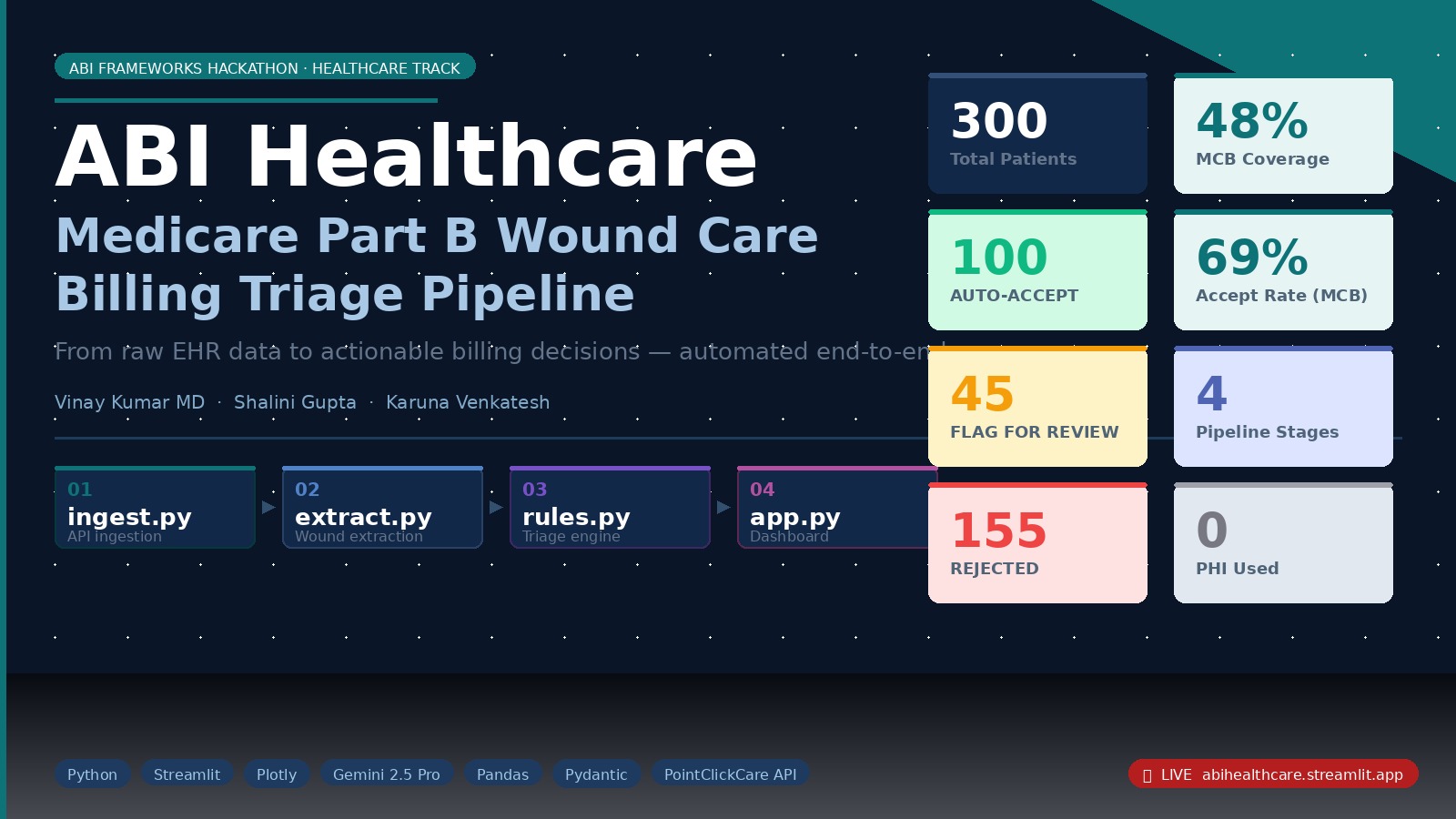
# 🩹 Wound Care Billing Triage: What, How & Why This document serves as the high-level presentation framework and elevator pitch for the Medicare Part B Wound Care Billing Triage & Analytics Platform. --- ## 1. What was built? We built an **automated clinical data pipeline and interactive analytics dashboard** designed to identify which patients qualify for wound care billing under Medicare Part B. It bridges the gap between raw, unstructured EHR data (from PointClickCare) and the billing office, turning clinical narratives into structured, billable claims. --- ## 2. How does it work? The platform operates in four optimized stages: * **Ingestion (`ingest.py`):** A multi-threaded, SQLite-backed persistent queue fetches patient data. It is rate-limit resilient (auto-retrying on 429s) and features a **60% payer short-circuit optimization**—instantly skipping downstream data collection for non-Medicare Part B patients to save API traffic. * **Extraction (`extract.py`):** A hybrid extraction engine. It first uses local Python JSON and regex utilities to parse structured assessments and simple progress notes at **zero token cost**. If a note is highly complex or ambiguous, it falls back to **Gemini 2.5 Pro** using Structured Outputs. All results are saved in a **persistent clinical cache** to ensure subsequent runs consume **zero tokens**. * **Triage (`rules.py`):** A deterministic rules engine that categorizes patients into three buckets: - `AUTO_ACCEPT`: Fully documented, single wound, active Medicare Part B. - `FLAG_FOR_REVIEW`: Missing critical parameters (e.g., depth) or multiple wounds. - `REJECT`: Ineligible (e.g., wrong payer). * **Visualization (`app.py`):** A premium, state-preserving Streamlit dashboard that provides clickable KPI cards, trend charts, documentation gap diagnostics (explaining *why* files are flagged), and a patient detail deep-dive. --- ## 3. Why does it matter? * **Unlocks Billable Revenue, Faster:** It replaces a slow, manual chart-review process. Billers can instantly identify and export 100% compliant claims (`AUTO_ACCEPT`) to submit immediately. * **Pinpoints Documentation Gaps:** Instead of guessing why a claim is held up, the dashboard tells the biller exactly what is missing (e.g., *"Incomplete clinical parameters missing: Depth"*), allowing them to target clinicians for specific corrections. * **Zero-Token Commercial Viability:** By combining local regex parsing, payer short-circuiting, and a persistent clinical cache, we reduced LLM token costs to **near-zero**. This makes the pipeline incredibly cheap to run at enterprise scale. * **Compliance and Audit Safety:** Strict multi-wound flagging and distinct operational rejection reasons prevent billing errors, protecting the company from compliance audits.