Builder project · Built at Pulse Foundry Private Hiring Hack
TruthLayer
TruthLayer: one trusted source of truth from systems that disagree, with every value traced to its e
- ✧ First Place
Tip: click @Pulse AI in the post to tag us.
From idea to reality
What we built
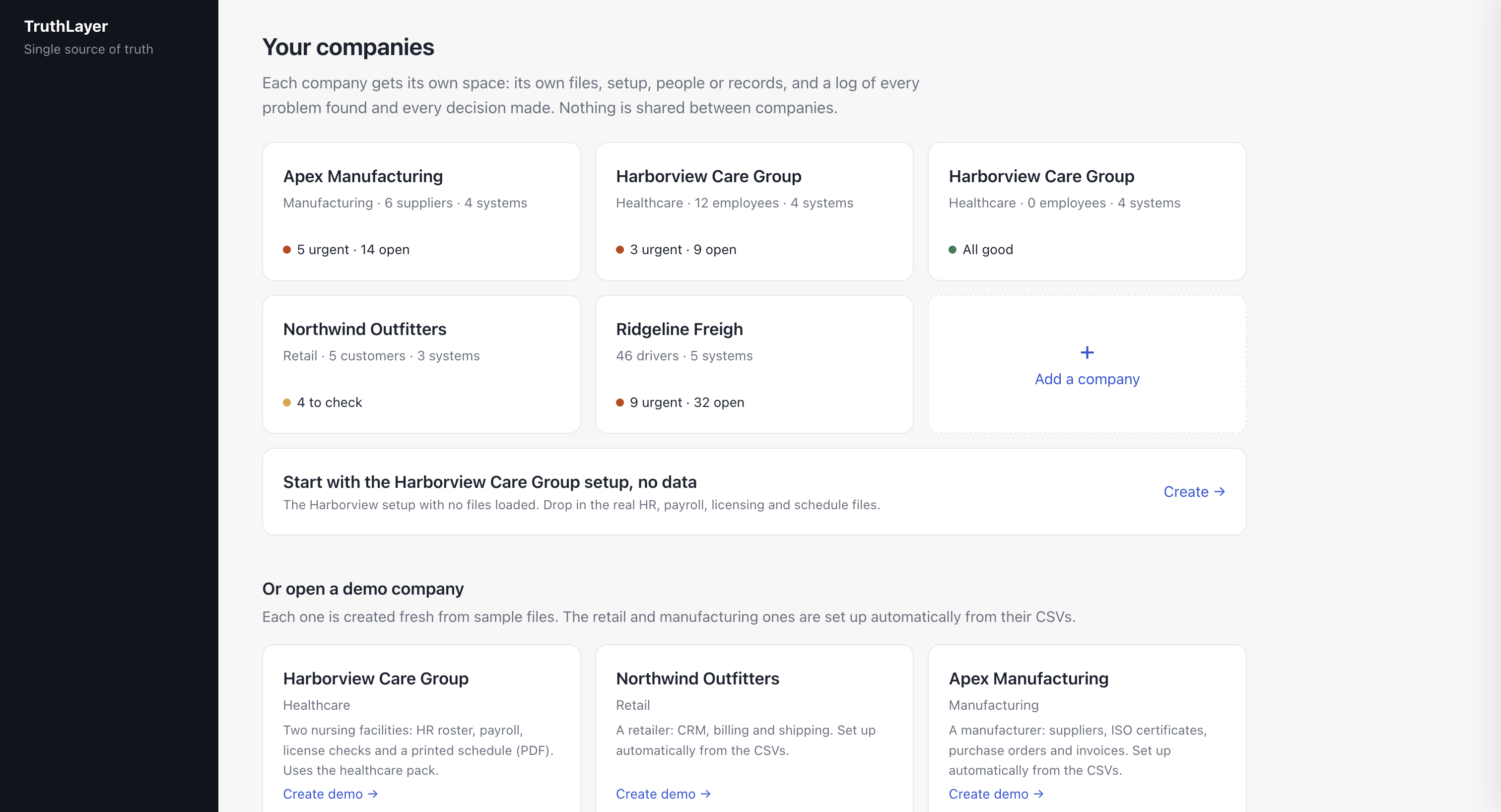
## What I built **TruthLayer** is a reusable source of truth for companies whose systems disagree. You drop in exports from different systems (CSV, Excel or PDF) and it does four things: - works out which records describe the same real person - shows what each system says about them - flags anything wrong, inconsistent or needing a human - remembers every decision a reviewer makes It's built for **Harborview Care Group** (HR roster, payroll, licensing CSVs and a printed schedule PDF). The engine has no healthcare logic in it, and I tested it on retail, manufacturing and trucking data without writing any new code. ## The problem At Harborview, the same nurse is "Sofia Reyes" in HR, "REYES, SOFIA" in payroll, and "Sofia Rayes" on a typo'd payroll line. Payroll and the schedule have no employee ID. A facility is "Harborview Bayside", "Bayside" or "BYS" depending on the system. Because nobody trusts any one system: - **Referrals** stall while someone checks by hand whether a licensed nurse is on shift. - **The quarterly state staffing report** takes weeks of hand-matching payroll hours to people and roles. - **Expiring licenses** are noticed too late, because each system has a different date. ## How it works Every upload runs through the same pipeline, and the source of truth is rebuilt from the raw files each time: 1. **Ingest:** Columns are matched by name, synonym and similarity, so renamed or reordered columns still load. It handles title rows, odd delimiters, Excel and PDF tables. A printed schedule PDF is read as a grid (people × days) and the shift legend gives each shift's hours. 2. **Normalize:** Dates, phone numbers, license numbers, facility and role codes, and "LAST, FIRST" names are converted to one comparable form. Values that can't be parsed are flagged, never guessed. 3. **Match:** Records are linked by exact IDs first, then names, nicknames (Marc = Marcus), initials and close spellings. - At 92% similarity or above, records link automatically. - Between 75% and 92%, the link waits for a person to confirm it. - Below that, the person becomes a visible "not in HR" profile, never a dropped row. 4. **Reconcile:** For each field, it collects what every system says. Trust is set per field, not by majority vote: HR for role and facility, licensing for license dates, payroll for hours. 5. **Check:** Readable, rule-based checks run on every profile: - expired or expiring credentials - credentials not verified recently - work done after a credential expired - missing records and duplicates - totals that should match (paid vs scheduled hours) - unusual statuses 6. **Decide:** Everything that needs a person becomes a plain-language to-do item with its evidence and one-click answers. **Decisions are remembered.** Each issue has a fingerprint built from the check, the person and the conflicting values. A decision re-applies on every re-upload and reopens if the data changes. **It learns from reviewers.** After someone marks an issue "Not a problem", they can turn that into a rule, for example *"not found in CDL report, only when position is Dispatcher."* Similar issues are then resolved automatically. Each one is labelled with the rule that closed it and can be undone. Critical issues are never auto-resolved. **Any company, any industry.** Each company gets its own workspace. A **guided setup** reads the files and suggests: - which file is the master list - how the other files link to it, based on how many values actually match - which coded values mean the same thing (`BYS` = Harborview Bayside, `RN` = Registered Nurse) - which checks to run A person reviews these suggestions on one screen before saving. ## How it solves Harborview's three problems | Problem | What TruthLayer shows | |---|---| | Referrals | A shift calendar per facility showing whether a licensed nurse with a clean record is on duty. An answer in seconds, not phone calls. | | State staffing report | Paid hours by week, facility and *trusted* role, compared with scheduled hours. Every questionable hour is flagged with a reason ("52% ready to report"), and the rest exports as CSV. | | Expiring licenses | Expired, expiring within 60 days, systems disagree, not verified recently, and **worked after expiry**. Dates come from the licensing service, not HR's copy. | Real flags from the sample data: - a nurse scheduled after her license lapsed - an employee paid twice - someone paid and scheduled who isn't in HR - a role that's LPN everywhere except payroll - 44 hours paid vs 36 scheduled ## Why it matters - **Trust is the product.** Nothing is silently fixed. Every value shows which file and row it came from, and every disagreement is visible. - **It's explainable on purpose.** Flags come from deterministic rules, not AI, so the same data always gives the same answer. Compliance needs that. AI is planned only for uncertain matches and setup suggestions, and a person still decides. - **One layer feeds every app.** Referral intake, state reporting and credential alerts can all read the same REST API instead of each re-cleaning the data. - **It's reusable.** A new client is a new workspace and a reviewed setup, not a new codebase. ## Proof - Automated tests plant known problems in messy files (renamed columns, bad encodings, borderless PDFs, Excel) and fail if any problem is missed. - The guided setup finds the planted problems in healthcare, retail and manufacturing data with no hand-written config. - A messy trucking dataset I generated (5 files, 21 planted problems) was set up from scratch in the UI, and **all 21 were flagged**. ## Stack Python, FastAPI and SQLite (one database per company; the plain SQL can move to Postgres), with pdfplumber and openpyxl for PDF and Excel. The UI is one page with no build step. See `GUIDE.md` for scaling, the data model, the API and the roadmap.