Builder project · Built at NYU SPS X Pulse Foundry
Lens
An AI search health tracker mapping query depth through an intent funnel to fix visibility gaps.
Tip: click @Pulse AI in the post to tag us.
From idea to reality
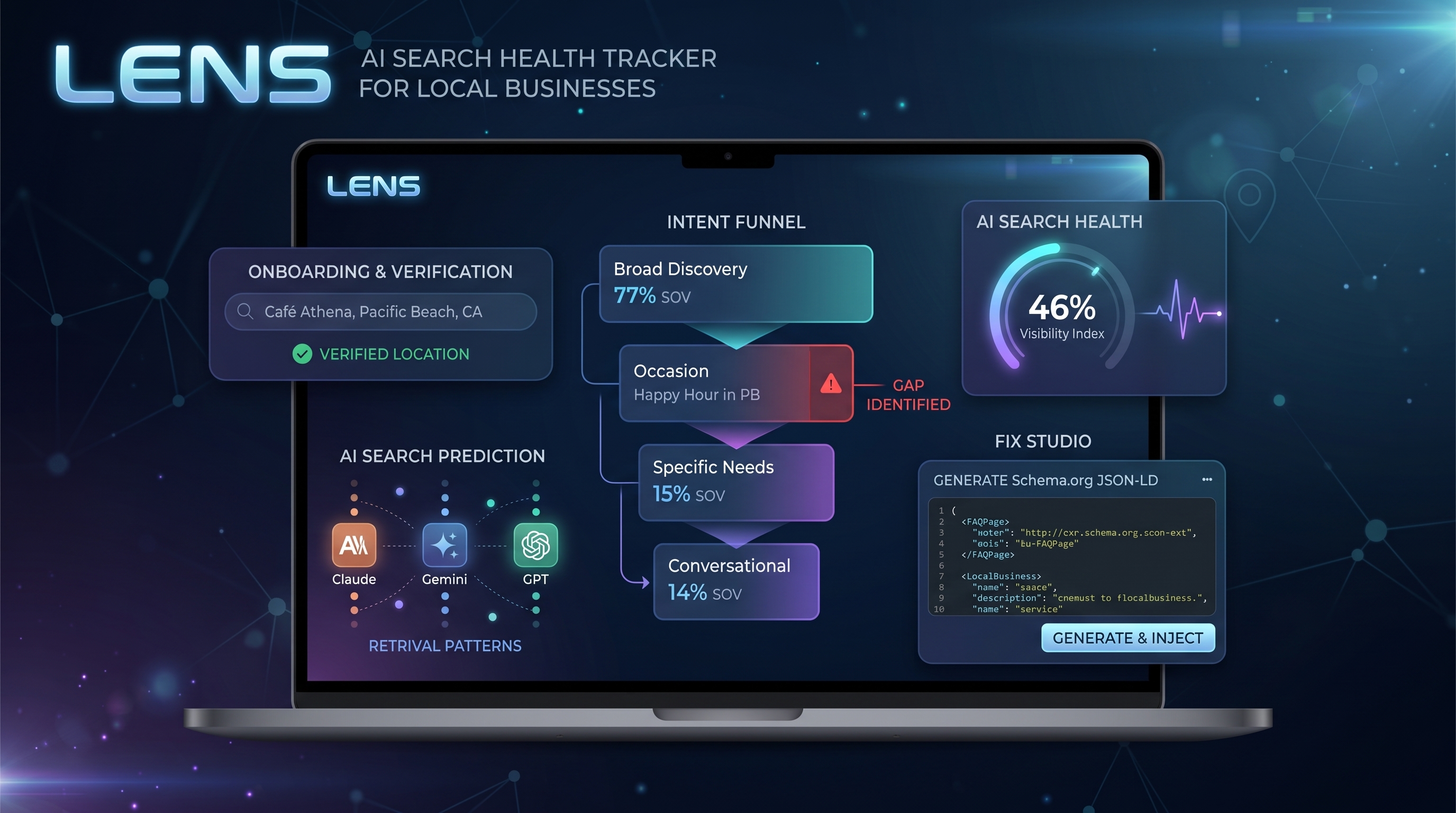
What we built
The Problem: The Missing Playbook for AI Search Search has shifted from blue links to conversational answers, but traditional SEO tools are fundamentally unequipped to measure this. There is an established, data-backed playbook for traditional SEO, but the route to top performance in AI search is completely missing. Customer habits, tool capabilities, and search data are shifting heavily. People are entering increasingly complex, highly specific queries, but the exact patterns of how they search—and how AI processes those searches—are still emerging. If a restaurant simply tracks raw mentions, they are flying blind. More importantly, AI models frequently hallucinate locations or blend competitor profiles if a business lacks a machine-readable identity. A local business needs to know exactly where they sit in the AI intent funnel, and exactly how the models are retrieving their data. What We Built: Lens Lens is an AI search health tracker and growth agent that systematically maps a restaurant's visibility across the customer journey. We built Lens to move beyond generic "AI SEO scores" and instead provide a verified, funnel-based diagnostic tool that translates missing data into actionable, ready-to-deploy optimizations across a restaurant's website, content, and local profiles. We designed our architecture around a strict verification-first approach and a four-stage growth loop. How It Works 1. Discovery & Prediction (Mapping the Unknown) We are predicting intent in a rapidly shifting landscape. Lens simulates a localized 50-query bank mapped to a strict intent funnel (Broad Discovery, Occasion, Specific Needs, and Conversational). Crucially, as queries get more complex, AI models process them methodically—retrieving data piece-by-piece to match specific entities and parameters. Lens deconstructs this retrieval mechanism to understand exactly how the AI is looking for answers, which allows us to maximize the precision of our fixes. Furthermore, while our initial demo targets specific pathways, our core architecture is designed to integrate the APIs of the "Big 3" LLMs (Claude, Gemini, ChatGPT) simultaneously. Once fully connected, this cross-platform data aggregation will be our ultimate differentiator. 2. Analytical Rigor (Finding the Narrative) Instead of just reporting a raw visibility score, Lens isolates the exact context where a restaurant loses. For Café Athena, our dashboard revealed a stark contrast: they win 77% of Broad Discovery searches (e.g., "best Greek food in PB") but plummet to 14% visibility in Occasion searches (e.g., "Happy hour with small plates"). The analysis engine identified that while competitors had rich FAQPage and Menu schemas mapping to these moments, Café Athena's happy hour details were trapped in unformatted text. 3. Actionability (The Fix Studio) Identifying a gap is only half the battle. Lens features a "Fix Studio" that transitions the agent from an analyst to a growth marketer. To close the Happy Hour visibility gap, the agent automatically generated ready-to-deploy FAQPage JSON-LD schema and localized website copy. By understanding the piece-by-piece retrieval method of the AI, the agent is constrained to inject only verified facts (e.g., daily 3–6 PM hours, Greek-mythology-themed cocktails) exactly where the LLMs are looking for them. 4. Measurability (Proving ROI) To close the loop, Lens includes a time-series tracking simulation. The dashboard maps the projected and actual impact of deploying the generated fixes, demonstrating how implementing the Happy Hour schema drives Café Athena's overall AI visibility from 46% to 58% over a 6-week period, tangibly increasing their Share of Voice against local competitors. Why It Matters Lens fundamentally changes how local businesses interact with generative search. By segmenting queries by depth and understanding the underlying retrieval mechanics of complex prompts, we prove that ranking for "best food" isn't enough if you are invisible for "Friday date night." We built an autonomous growth team that diagnoses the exact commercial moment a business is losing, and writes the precise code and copy needed to win it back.