Builder project · Built at NYU SPS X Pulse Foundry
Café Athena: aiso team
We measured where Athena ranks, found out why, fixed what we could, tested the fix honestly, and tha
Tip: click @Pulse AI in the post to tag us.
From idea to reality
What we built
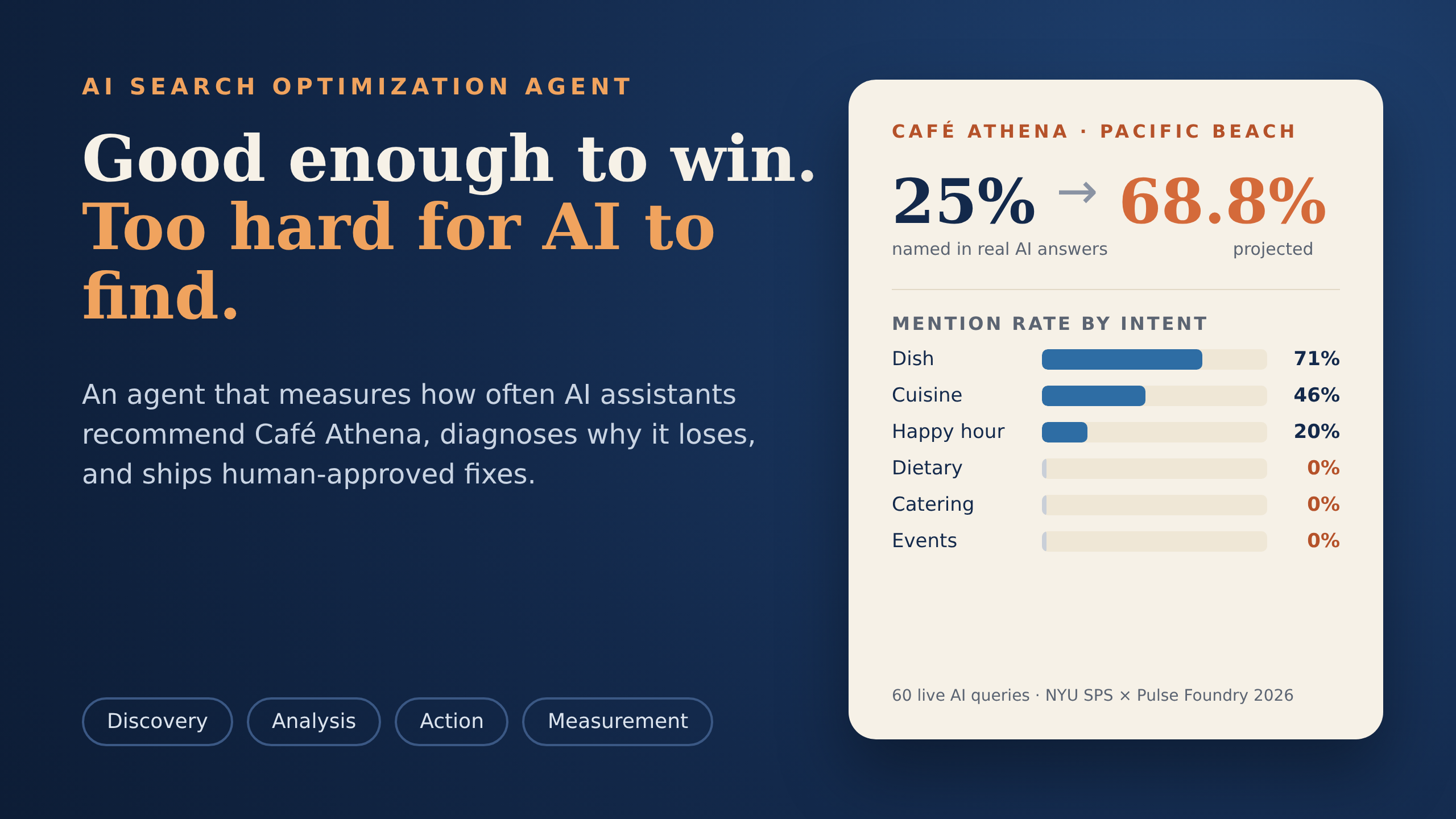
What we built An AI Search Optimization (AISO) agent for Café Athena (Pacific Beach, San Diego). It measures how often LLM assistants recommend the restaurant, finds out why it loses, generates evidence-backed fixes that a human approves before publishing, and tracks visibility over time. It’s a closed Discovery → Analysis → Action → Measurement loop: four Python stages, a reproducible dashboard and an audit log. How it works Discovery (discovery.py): a 60-query bank across 9 intent categories (cuisine, dish, dietary, happy hour, occasion, group events, catering, price, broad), run against Claude Sonnet 5.5 with live web search. A second LLM pass extracts the ordered list of restaurants named in each answer. We log mention, rank, competitor set and cited URLs. Adapters for GPT, Gemini and Perplexity are built in. Analysis (analysis.py): An on-site crawl of Athena and the top 5 competitors: JSON-LD/microdata @type parsing, page coverage, and regex checks for selling points. An off-site audit using web-grounded LLM research: review volume, best-of lists, directories. An LLM diagnosis that must cite evidence, producing 8 gaps ranked by impact ÷ effort. Action (action.py): generates 6 intent-targeted pages, Restaurant and FAQPage schema, and outreach drafts. It is constrained to verified facts: anything unknown becomes [CONFIRM], and a second pass fills placeholders from the restaurant’s own site. Each draft passes a human y/n gate. Every action is timestamped in actions_log.csv and can be reverted with undo. Measurement: (a) Controlled head-to-head (measure.py): on the 20 lost queries, Claude reads Athena’s page against the winners’ real sites (equal length, shuffled order). (b) Retrieval simulation: BM25 retrieves the top 3 of 21 real web pages per query; the “assistant” ranks restaurants by their order on those pages; before and after adding the new pages. (c) Weekly re-run of the same query bank as the true longitudinal metric (build_dashboard.py). Key findings Mention rate 25% (15 of 60), top-3 rate 8%, mean position 5.07. Share of voice is 2.8%, enough for #1 of 262 restaurants named, which shows a highly fragmented answer space. The gap depends on intent: dish 71%, cuisine 46%, but 0% on dietary (8), group events (8) and catering (2). These are the segments the restaurant monetizes most. Citation concentration: Yelp 95, Tripadvisor 29, OpenTable 21, followed by niche directories (findmeglutenfree 11, Peerspace 6, Tagvenue 4). Cafeathena.com was cited 3 times. Athena has 0 Restaurant, Menu or FAQ schema, 2 crawlable pages, and 3–8× fewer reviews than the winning competitors. Retrieval, not relevance, is the bottleneck. In the head-to-head, Athena is named 100% of the time and ranked #1 in 80% on queries where real search gives it 0%. When the model sees the page, Athena wins; the page just isn’t being retrieved. Projected lift: with the new pages indexed, the retrieval simulation rises from 37.5% → 68.8%, with new top-3 placements on rehearsal-dinner, group, catering, tapas and date-night queries. Why it matters AI assistants compress a results page into one recommendation, and the inputs are opaque, citation-driven and intent-specific. Small businesses have no visibility into this. Our agent turns that into a measurable funnel: query-level share of voice, citation-source attribution, and a separation between retrieval failures and persuasion failures. That separation tells the owner where effort pays: structured data, intent-specific pages and directory presence, rather than rewriting copy. Every change is human-approved, fact-constrained and logged, so it can be trusted to keep running week after week. Limits: one platform and one sample per query. The lift is a simulation, to be confirmed by the weekly re-run.